Best Destinations for Soulful Restorative Solo Trips in the U.S.
If you’re searching for the best destinations for soulful restorative solo trips, you’re probably not looking for party scenes or must‑tick attractions. You want quiet that doesn’t feel lonely, nature that steadies your pulse, wellness that isn’t performative, and towns where a solo diner feels welcome at the bar. As an American who frequently travels alone (and also with family, my partner, and my boisterous nephew), I’ve learned that the most restorative solo spots share a few traits: easy access to trails or water, small but high‑quality food scenes, lodgings that encourage unplugging, and logistics you can manage without stress.
Below are U.S. destinations that consistently deliver. For each, I include what works especially well for solo travelers, plus notes on how the same place plays differently for couples, families with kids, and older travelers.
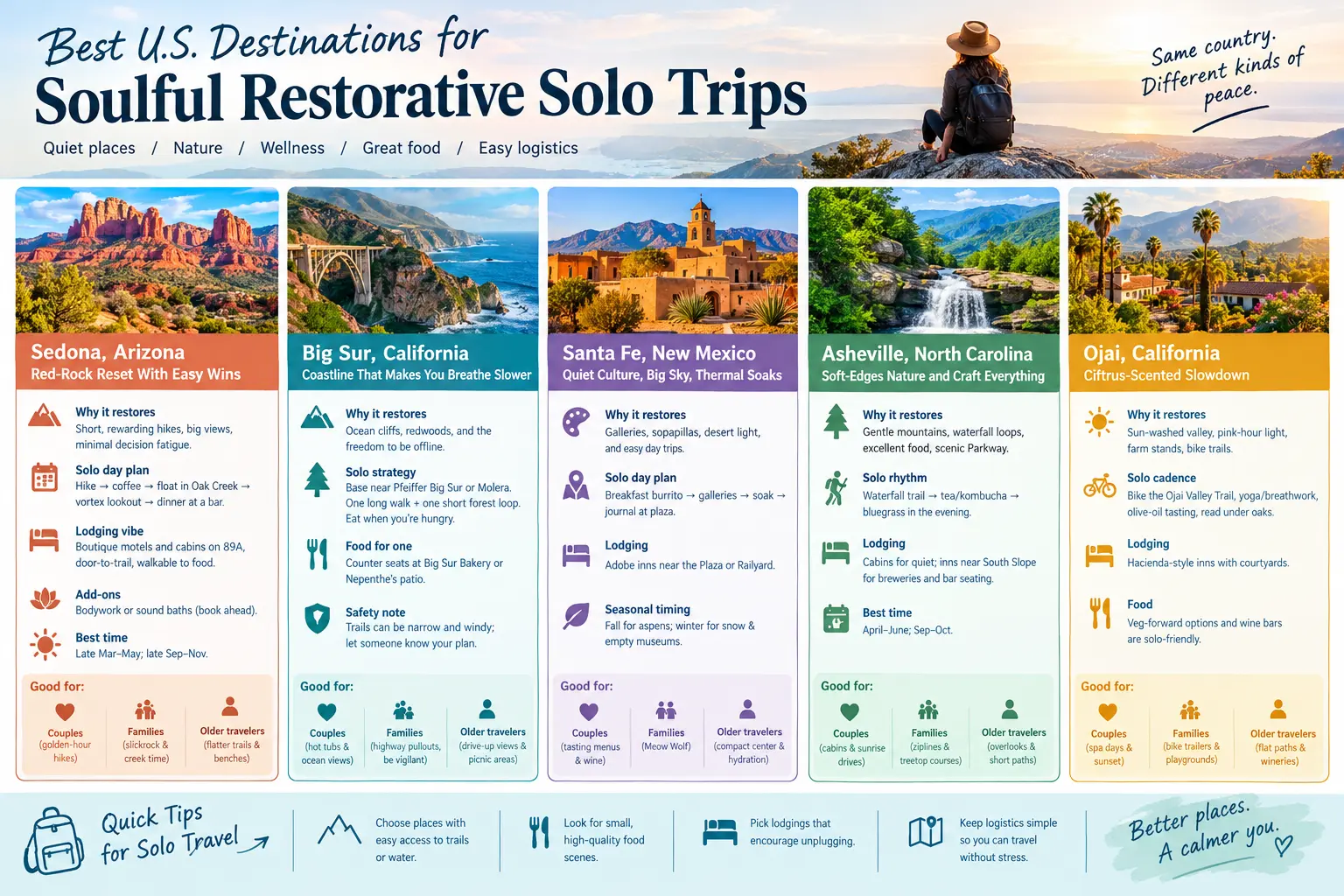
Sedona, Arizona: Red‑Rock Reset With Easy Wins
- Why it restores: The landscape itself does half the work. Short, rewarding hikes (Bell Rock, Fay Canyon) deliver big views with minimal decision fatigue. Solo tip: sunrise trailheads are relaxed and feel safe thanks to steady foot traffic without crowds.
- How I structure a solo day: Early hike; late‑morning coffee in the Village of Oak Creek; a midday float or cold‑plunge at Oak Creek Crossing; late‑afternoon vortex lookout at Airport Mesa; early dinner at a spot with bar seating so solo diners blend in.
- Lodging vibe: Boutique motels and cabins on 89A are perfect for solo travelers—door‑to‑trail in minutes, yet walkable to food.
- Restorative add‑ons: Bodywork or sound‑bath sessions are common here—book a day ahead, not weeks.
- Weather/when to go: Shoulder seasons (late March–May; late September–November) keep temps and prices moderate.
- Couples vs. families vs. older travelers:
- Couples: Sunset jeep tours are fun together, but for solo travelers the same energy can feel too amped; stick to golden‑hour hikes.
- Families: Slickrock scrambles entertain kids; plan shaded creek time midday.
- Older travelers: Choose flatter trails (Baldwin, Bell Rock Pathway); many have benches and frequent turnarounds.
Big Sur, California: Coastline That Makes You Breathe Slower
- Why it restores: Ocean cliffs, towering redwoods, and the permission to be offline (cell coverage is scarce).
- Solo strategy: Base yourself at a simple cabin or yurt between Pfeiffer Big Sur State Park and Andrew Molera. Build your day around one long walk (Creamery Meadow to the beach at Molera) and one short forest loop. Eat when you’re hungry; no reservations stress.
- Food for one: Counter seats at Big Sur Bakery or Nepenthe’s back patio make solo meals feel natural.
- Safety note: Trails can be narrow and windy; let someone at your lodging know your plan if heading out alone.
- Couples/families/older travelers:
- Couples: Hot tubs with ocean views are everywhere—great together, less essential solo.
- Families: Highway 1 pullouts are frequent, but cliff edges and limited guardrails mean constant vigilance.
- Older travelers: Many viewpoints are essentially drive‑up; pick picnic areas with bathrooms (Pfeiffer Big Sur SP).
Santa Fe, New Mexico: Quiet Culture, Big Sky, Thermal Soaks
- Why it restores: The combo of galleries, sopapillas, and desert light is low‑effort, high‑nourishment. Easy day trips to Bandelier’s cliff dwellings or soaking at Ojo Santa Fe.
- Solo day plan: Start with a green‑chile breakfast burrito, wander the Railyard galleries late morning, soak mid‑afternoon, and journal on a plaza bench at dusk.
- Lodging: Small adobe inns near the Plaza or the Railyard feel safe and walkable.
- Seasonal timing: Fall is crisp with aspens turning gold in the Sangre de Cristos; winter offers snow‑dusted adobe and empty museums.
- Who else it suits:
- Couples: Shared tasting menus and wine pairings are lovely here.
- Families: Meow Wolf keeps kids enthralled for hours.
- Older travelers: Compact historic center with benches and frequent rest stops; altitude is 7,000+ feet—hydrate and pace yourself.
Asheville, North Carolina + Blue Ridge Parkway: Soft‑Edges Nature and Craft Everything
- Why it restores: Gentle mountains, waterfall loops, and a food scene that’s casual but excellent. The Parkway provides curated vistas without planning gymnastics.
- Solo rhythm: Morning on a waterfall trail (Looking Glass Falls/Brevard area), late‑afternoon tea or kombucha flight, bluegrass in the evening.
- Lodging: Small cabins outside town for quiet nights; in town, inns near South Slope put you steps from breweries with friendly bar seating.
- Weather window: April–June and September–October for cool air and color.
- Variations by group:
- Couples: Cabin hot tubs and sunrise drives to Craggy Gardens are romantic.
- Families: The Adventure Center of Asheville (ziplines/treetop courses) is a built‑in energy outlet.
- Older travelers: The Parkway’s overlooks are a gift; most have short, even paths from parking lots.
Ojai, California: Citrus‑Scented Slowdown With Bike Paths and Yoga
- Why it restores: Sun‑washed valley, pink‑hour “Ojai pink moment,” farm stands, and mellow bike trails.
- Solo cadence: Borrow a cruiser bike, loop the paved Ojai Valley Trail, book a mid‑day yoga or breathwork session, and end with olive‑oil tasting and a book under oaks.
- Lodging: Small hacienda‑style inns with courtyards—quiet but social if you want conversation.
- Food: Tons of veg‑forward options and wine bars comfortable for solo patrons.
- For others:
- Couples: Spa‑day plus sunset at Meditation Mount is peak Ojai.
- Families: Easy bike trailers and playgrounds, but many restaurants lean hushed.
- Older travelers: Flat paths and frequent benches make this easy on joints.
Cannon Beach, Oregon: Tidal Rhythms and Long Walks
- Why it restores: Miles of hard‑packed sand for meditative walks, Haystack Rock as your daily landmark, evergreen‑lined air that smells clean even on misty days.
- Solo plan: Time your strolls to low tide for tide‑pooling; read by a fireplace when the fog rolls in. If you’re introverted, the weather gives you social permission to nest.
- Lodging: Fireplaces and oceanfront balconies are common; many inns include loaner rain gear.
- Differences by group:
- Couples: Storm‑watching is romantic; book a room with big windows.
- Families: Beach is wide and forgiving; watch sneaker waves and keep kids close at tide pools.
- Older travelers: Many beachfront inns have elevators and indoor lounges with full ocean views.
St. George, Utah (Gateway to Zion, Snow Canyon): Red‑Rock Calm Without Zion Crowds
- Why it restores: You get the drama without the pressure of racing shuttle schedules. Snow Canyon State Park is a solo hiker’s dream—short lava‑flow loops, slot‑style canyons, and broad views.
- Solo game plan: Sunrise Petrified Dunes, mid‑day iced coffee in town, golden‑hour walk at Jenny’s Canyon. If you want a Zion dose, go late afternoon when day‑trippers are gone; do Pa’rus Trail for a low‑stress river walk.
- Lodging: Minimalist casitas and small hotels with kitchenettes—cook simple meals and sleep early.
- Family/couples/older:
- Couples: Canyoneering guides turn it into an adventure day.
- Families: Sand dunes and short trails are kid‑proof; bring sand toys.
- Older travelers: Drive‑up viewpoints in Snow Canyon; many trails have benches under shade structures.
Hudson Valley, New York: Rail Trails, River Light, Farm Stands
- Why it restores: Slow trains and slower towns. Kingston, Beacon, and Hudson offer galleries and cafes with ample solo seating; the Walkway Over the Hudson and Ashokan Rail Trail are gentle, car‑free miles.
- Solo day: Morning rail‑trail ride, noon farmers’ market, late‑day Dia Beacon or Storm King Art Center (midweek is blissfully quiet).
- Lodging: Converted farmhouses and riverside inns; choose places with loaner bikes if you’re car‑free.
- Group notes:
- Couples: Winery patios and long dinners.
- Families: Storm King is an open‑air sculpture playground with room to roam.
- Older travelers: Rail trails are flat, well‑maintained, and dotted with bathrooms.
Olympic Peninsula, Washington: Three Ecosystems, One Loop
- Why it restores: You can stack rainforest, alpine, and wild coast in two days with minimal planning. The sensory shift alone is healing.
- Solo structure: Base in Port Angeles or Forks. Do an early loop through Hoh Rain Forest (Hall of Mosses) and a sunset at Rialto or Second Beach. Next day, Hurricane Ridge for alpine views.
- Practical tip: Weather swings—pack a lightweight shell and warm hat year‑round. Download maps; service is patchy.
- With others:
- Couples: Tide‑pool explorations feel like a shared discovery project.
- Families: Beaches are huge; keep an eye on tide timing and logs.
- Older travelers: Many signature views are near parking; ask rangers for current accessibility info.
Taos, New Mexico: Quiet Altitude With Texture
- Why it restores: High‑desert light, Rio Grande Gorge Bridge perspective, and a creative community that welcomes solo artists and writers.
- Solo plan: Morning coffee, short hike at Rift Valley or Williams Lake (if acclimated), golden‑hour at the Gorge, early dinner and stargazing.
- Lodging: Small adobe casitas with fireplaces are inexpensive off‑season.
- Group differences:
- Couples: Shared gallery crawls and long dinners.
- Families: River rafting in season; otherwise, plan for short attention spans at galleries.
- Older travelers: High elevation—add a rest day on arrival.
Whitefish + Glacier Gateway, Montana: Clean Lakes, Big Sky, Pine‑Scented Air
- Why it restores: A lake you can float in, a small town with friendly bar seating, and day trips into Glacier National Park without staying inside the park.
- Solo approach: Paddleboard Whitefish Lake in the morning, nap, then head into Glacier late afternoon for quieter overlooks. If going deep into the park, share your plan with your inn.
- Lodging: Alpine‑style inns and small motels within walking distance of Main Street.
- Others:
- Couples: Going‑to‑the‑Sun Road at golden hour is a joint memory.
- Families: Junior Ranger activities help structure days.
- Older travelers: Boardwalk trails and scenic drives reduce exertion.
How Solo Travel Here Differs From Going With Others
- Decision load: Alone, you can pick one “anchor” per day (a hike, soak, or museum) and defend your recharge time. With partners or kids, compromise expands the day and compresses rest.
- Meal pacing: Solo, counter seating and early dinners reduce wait times and noise. With families, choose spots with outdoor seating and space to fidget; for older relatives, prioritize parking and short walks.
- Activity selection: Restorative solo trips mean fewer adrenaline spikes. With couples, you can add one “shared challenge” (a sunrise summit). With kids, design for micro‑adventures every 90 minutes. With seniors, favor scenic drives and short loops with benches.
Practical Playbook for a Soulful, Restorative Solo Trip
- Choose your “base mood”: ocean fog (Cannon Beach), desert sun (Sedona/Taos), forest hush (Olympic), clean mountain air (Whitefish/Asheville), or citrus‑valley warmth (Ojai). Matching place to mood is 80% of the result.
- Build one‑anchor days:
- Morning: the most contemplative hour; put your nature time here.
- Midday: nourishment and a low‑stimulus rest (soak, nap, hammock, gallery).
- Dusk: a simple ritual—walk to a viewpoint, journal three sentences, breathe.
- Lodging filters for solo wellness:
- Walkability to a cafe/grocer within 10 minutes.
- Quiet hours or adult‑friendly ambience if you’re noise‑sensitive.
- Onsite or nearby nature access so you don’t have to drive daily.
- Getting around:
- If you don’t want to rent a car, choose bases with rail trails (Hudson Valley), shuttle systems (Asheville/Blue Ridge Parkway visitor centers have seasonal shuttles for certain areas), or walkable town cores (Santa Fe, Ojai, Cannon Beach).
- If you do rent a car: request all‑weather tires in mountain or shoulder seasons; confirm spare tire presence.
- Safety without anxiety:
- Share a daily plan with one friend plus your lodging host.
- Carry a small first‑aid kit, headlamp, and a charged battery pack.
- Download offline maps; take a photo of trailhead maps before you start.
- Budgeting cues:
- Off‑season midweek in these places can cut lodging by 25–50%.
- Build two “splurge anchors” per trip (e.g., a guided sound bath, a room with a fireplace) and keep meals simple otherwise.
- Packing for restoration:
- Layers you can re‑wear, a soft beanie, sandals plus trail shoes, a compact down or fleece, swimsuit (hot springs, hotel tubs, cold dips).
- A physical book or e‑reader to break the scrolling habit.
- Earplugs and a silky eye mask for unfamiliar rooms.
- Social but not overstimulated:
- Sit at the bar for early dinners; chat when invited, bow out kindly.
- Join one guided activity (for safety and light connection), then keep the rest self‑led.
Mini Itineraries (2 Nights Each)
- Sedona Reset:
- Day 1: Arrive, stroll Tlaquepaque art village, sunset at Airport Mesa.
- Day 2: Sunrise at Bell Rock; midday Oak Creek cold plunge; 60‑minute massage; early dinner; stargaze.
- Day 3: Short trail (Fay Canyon), coffee, out by noon.
- Blue Ridge Unwind (Asheville base):
- Day 1: Afternoon check‑in; golden‑hour drive on the Parkway; simple dinner.
- Day 2: Waterfall loop near Brevard; nap; live bluegrass.
- Day 3: Riverwalk coffee; bookstore hour; home.
- Ojai Soft Landing:
- Day 1: Valley Trail ride; farm‑stand picnic; evening yoga.
- Day 2: Meditation Mount sunrise; olive oil tasting; creek‑side read.
- Day 3: Slow breakfast; short trail at Shelf Road; depart.
Accessibility and Energy Management
- If you’re managing chronic pain, altitude, or energy variability:
- Favor drive‑up vistas (Blue Ridge, Olympic, Sedona’s Airport Mesa).
- Use “pacing ladders”: short outing, rest, short outing, rest.
- Pick lodging with an outdoor nook (balcony, courtyard) so nature is reachable without an excursion.
How These Trips Compare by Traveler Type (Quick Matrix)
- Solo: maximize mornings, pick a base with walkable food, plan one guided activity for connection.
- Couples: add one shared challenge and one shared soak; book one truly quiet night (no TV, private deck).
- Families with kids: design for water contact (beach, creek, splash pad) daily; plan food within 10 minutes of activities.
- Older travelers: prioritize benches, bathrooms, and even surfaces; ask rangers or visitor centers for current accessibility notes, as trail conditions change after storms.
Common Mistakes That Undercut Restoration
- Overscheduling: Three anchors in a day is two too many.
- Chasing peak lists: Choose “nearby beautiful” over “Instagram famous.”
- Ignoring shoulder seasons: That’s when prices drop and locals exhale.
- Bringing work “just in case”: If you must, cap it to a 30‑minute inbox triage once daily, then airplane mode.
FAQs: Best Destinations for Soulful Restorative Solo Trips
Q: I’m new to solo travel. Which destination is the least stressful first step?
A: Asheville (for soft trails and a friendly town core) or Ojai (for flat bike paths and wellness options). Both have walkable food, supportive atmospheres, and straightforward logistics.
Q: I don’t want to rent a car. Where can I still have a restorative time?
A: Santa Fe (walkable core and rideshares), Cannon Beach (once you arrive, you can live on foot), and select Hudson Valley towns with rail access (Beacon/Hudson) paired with rideshares and rail trails.
Q: I want water more than mountains. Which coastal picks are truly calming?
A: Cannon Beach for wide, meditative walks; Big Sur for dramatic views and enforced digital detox. If warmth matters, consider Ojai’s pools or Santa Fe/Ojo spa soaks instead of the ocean.
Q: I’m on a tight budget. How do I keep costs low without losing the restorative vibe?
A: Travel midweek in shoulder seasons, pick an inn with a kitchenette, and splurge on one paid wellness experience while keeping the rest free (sunrise hikes, rail‑trail rides, beach walks).
Q: Is it safe to hike alone?
A: Choose popular, well‑marked trails near towns; start early; tell someone your plan; carry water, a headlamp, and a small first‑aid kit; and turn around before you’re tired. If a trailhead feels wrong, leave—your intuition is part of your gear.
Q: I’m traveling with my older parent—what’s a shared restorative plan?
A: Blue Ridge Parkway or the Olympic Peninsula. Design days around drive‑up viewpoints, short boardwalk loops, frequent benches, and scenic picnic stops. Keep hydration, bathrooms, and shade in mind.
Q: How long should a restorative solo trip be?
A: Two to four nights is the sweet spot for most people: long enough to downshift, short enough to protect your energy and budget. Use one anchor activity per day and end each day with a dusk ritual.
Choose the place that fits your current nervous system—soft forest, warm desert, or windy coast—and keep your days deliberately simple. Restoration isn’t a checklist; it’s the space you leave between the moments.